This final paper was part of the coursework for the Ethnographic Practicum courses ANT473 and ANT6200, “Ethnography of the University 2019: Focus on Time” I met with Dana sometime towards the end of October in her office at College X, after having booked an appointment for financial counseling at the registrar’s. Having been introduced to … Continue reading
Author Archives: Emily-Camille Gilbert
Imagining Family-Friendly, By Priya Saibel (Ethnography of the University 2019: Focus on Time)
This final paper was part of the coursework for the Ethnographic Practicum courses ANT473 and ANT6200, “Ethnography of the University 2019: Focus on Time” What does ‘family-friendly’ mean to students at U of T? How did the Family Care Office (FCO) emerge at the University? And, how does the University address ‘family-friendly?’ This paper considers … Continue reading
A Peripat(h)etic Journey, By Ali Azhar (Ethnography of the University 2019: Focus on Time)
This final paper was part of the coursework for the Ethnographic Practicum courses ANT473 and ANT6200, “Ethnography of the University 2019: Focus on Time” Introduction: My peripatetic journey is modeled along the lines of Laurence Sterne’s travel account of his fictional character, Yorick, who engages in sentimental interactions with people, animals and objects he encounters … Continue reading
ANT 473HF Ethnographic Practicum Syllabus (Ethnography of the University 2019: Focus on Time)
University of Toronto, Department of Anthropology ANT 473HF Ethnographic Practicum: The University 2019 Theme: TimeInstructor Prof. Tania Li, Mondays 10-1 pm Participants in this class conduct an independent ethnographic inquiry, analyse data, write it up, present it, and publish it on the Ethnography Lab website as an original contribution to knowledge. The premise of the … Continue reading
Doing “good work”: the intersections of progress, innovation, and virtue at the University of Toronto, By Morgan O’Brien (Ethnography of the University 2019: Focus on Time)
This final paper was part of the coursework for the Ethnographic Practicum courses ANT473 and ANT6200, “Ethnography of the University 2019: Focus on Time” Introduction This ethnographic project began with the idea of a race between institutions. Securing a position at the top of the annual national and international university ranking scales is a high … Continue reading
Winter 2020 Events
The Ethnography Lab hosts a regular speaker series, workshop series, and methods safé during the academic year (September-April). These events take place in the University of Toronto anthropology building, room AP330 at 19 Russell Street, Toronto. In addition, our various interest groups (see the “Groups” drop-down menu in the main menu) frequently plan and organize … Continue reading
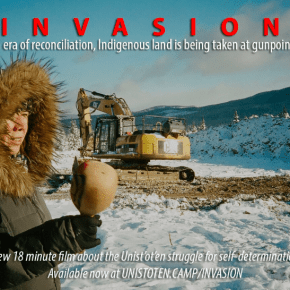
Please join the AGSU and Ethnography Lab for a film screening of the short documentary Invasion
When: Friday, February 14th, 2:30PM Where: Ethnography Lab Boardroom The AGSU and Ethnography Lab will be hosting a film screening of the short documentary Invasion, followed by a discussion about the work of Wet’suwet’en land and water protectors and ways that anthropologists living and working on Indigenous lands can act in solidarity with the Wet’suwet’en … Continue reading
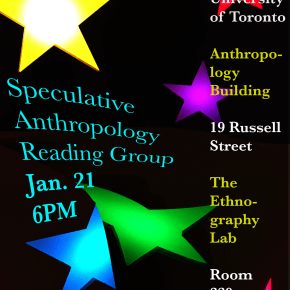
Speculative Anthropology Reading Group announcement
The Ethnographic Ear: Working with/in Sound
Date: Wednesday February 12, 2020Time: 12 NoonLocation: Room 330, Anthropology Bldg, 19 Russell Street, Toronto On Wednesday, February 12, University of Toronto Ethnomusicology Prof. Farzaneh Hemmasi and doctoral candidate Nil Basdurak will introduce participants to some of the central questions, theories, challenges and opportunities associated with ethnographic approaches to sound, sounding and listening at Ethnography Lab‘s Methods Café. They will … Continue reading
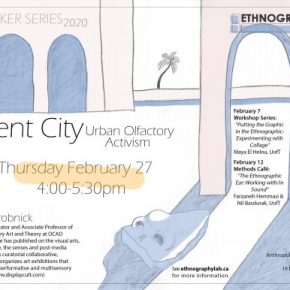
Please join us for Scent City: Urban Olfactory Activism by Jim Drobnick (OCAD)
Date: Thursday February 27, 2020Time: 4:00-5:30PMLocation: Room 330, Anthropology Bldg, 19 Russell Street, Toronto Abstract: The city constitutes a prime battleground for olfactory politics. The large population, the competing interests, the variety of stakeholders, and the dynamic pace of redevelopment all contribute to contestations about the best use of the public commons that is the atmosphere. … Continue reading