A Final Report By Yunshan Li My research question is generated from my interviews with Student Engagement (below refers to SE) employees on the topic of their work related to student clubs. One interviewee said, “Could they do these things without us? Probably.” Then he explained the difficulty students could meet without their support, but I … Continue reading
Tag Archives: teaching
“It’s so hard to get information out to students.”
By Yunshan Li As one division in Student Life, a main challenge that Student Engagement (responsible for clubs and leadership development relevant matters) meets is they find it difficult to let students know what is happening. One main reason is they do not have their own social media accounts. If they want to announce something, such … Continue reading
The “Identity Crisis” in the Work of Learning Strategy: An Ethnographic Glance of the Higher Education Landscape at the University of Toronto
A Final Report By Yihang Xu “… even just in the few conversations we’ve had, you’ll notice that there’s almost a departmental identity crisis…” —— Grace, a staff member of the CLSS Introduction “Learning how to learn” may seem unusual, as the ability to learn is often considered an implicit skill for university students, particularly … Continue reading
Navigating Identity: Learning Strategists and the Tension Between Care and Boundaries
By Yihang Xu “… even just in the few conversations we’ve had, you’ll notice that there’s almost a departmental identity crisis…” —— Grace, Learning Strategist Grace is right. Through my interviews with learning strategists in the Center for Learning Strategy Support (CLSS) at the University of Toronto (UofT), I’ve noticed an identity crisis among them. … Continue reading
Neoliberal Implications in the Fragmentation of Student Services through the renamings of Center for Learning Strategy Support (CLSS)
By Yihang Xu The Center for Learning Strategy Support (CLSS) helps students develop strategies and practices to enhance their learning and study skills. As one of the major units within the Student Life Department at the University of Toronto (UofT), CLSS didn’t always exist in its current form. According to my informant, Eric (a pseudonym), … Continue reading
Scaling Academic Support Services: Consumerist Implications in Higher Education
By Yihang Xu The Center for Learning Strategy Support (CLSS) is a major academic support service provider within the University of Toronto (UofT). Its focus is on helping students improve their learning habits and academic outcomes. During my interviews with the learning strategists there, I found that they frequently use the word “scale” to describe … Continue reading
The Art of Building Rapport with Professionals
By Richard Wu One might think that, for the student ethnographic researcher, Student Life offers abundant opportunities for immersive field research. After all, like other students, the student researcher should in principle have equal access to the many opportunities for student engagement and development which Student Life is mandated to provide. Yet, as a student … Continue reading
The Business of Helping: The Ethical Implications of Student Tutoring at UofT
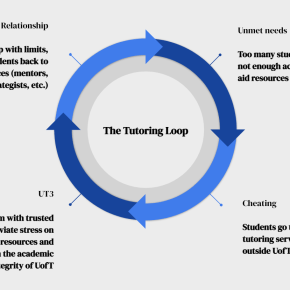
A Final Report By Molly McGouran Introduction Why do we behave with integrity? This was the first question I was asked when I logged onto “Ethics in Tutoring,” the first of my Zoom sessions in the Tutor Training Program. As I sat at my laptop, confronted with this question, I was opened up to the … Continue reading
When the Field Says No: Researching Student Life Without Student Voices
By Molly McGouran How do you conduct research on a university without talking to students? It is a question that caught me off guard during my fieldwork and, at first, felt incredibly limiting. I had started with what I thought was a clear, straightforward plan: observe, interact, and interview students at the University of Toronto. … Continue reading
The Price of Support: How The UT3 Program Complicates Academic Aid
By Molly McGouran While conducting research into the University of Toronto Tutor Training Program (UT3), I found myself caught in a web of questions and answers that seemed to lead me in circles. The more fieldwork I did, the more it felt like trying to solve a puzzle where every piece connected to another in … Continue reading