By Richard Wu How great would it be if someone, perhaps a more senior student, can show you the ropes about how to succeed at U of T? Someone with the right personality, background, and interests who can click with you and provide support and guidance? This might sound great. But how do you get … Continue reading
Category Archives: Ethnography of the University: Focus on Student Life 2024
Over the past two decades, Student Life has emerged at the University of Toronto and elsewhere as a domain where various aspects of student life become subject to expert management with the aim of facilitating learning, enhancing well-being, minimizing stress, and promoting a healthy and productive university experience. Yet for most students at U of T, Student Life (like most parts of the institution) is a black box: they have no idea what goes on there.
Students in the 2024 Ethnographic Practicum set out to address a deceptively simple question: what does student life do? The website https://studentlife.utoronto.ca/ provides a list of programs but behind each of these, there is a story. How did this program come to be? What are the problems to which this program is offered as a solution? How do student life managers and staff go about their everyday work? How do they explain, promote, evaluate, and defend their work to different actors (students, faculty, administrators, senior managers, auditors, rankings agencies, the media, parents, and other universities?).
Students from Prof. Tania Li’s fall 2024 course entitled ‘Ethnographic Practicum: Ethnography of the University’ compiled blog posts and documents from their experience conducting ethnographies of Student Life at the University of Toronto.
The Peer Mentorship Contract
By Richard Wu Let me tell a story of how “contract” comes to be used in student peer mentorship. In theory, university students could form stable, mutually beneficial relations to help each other succeed. In such peer mentoring relations, more junior students are mentees who could benefit from the guidance and support of more senior … Continue reading
The Business of Helping: The Ethical Implications of Student Tutoring at UofT
A Final Report By Molly McGouran Introduction Why do we behave with integrity? This was the first question I was asked when I logged onto “Ethics in Tutoring,” the first of my Zoom sessions in the Tutor Training Program. As I sat at my laptop, confronted with this question, I was opened up to the … Continue reading
When the Field Says No: Researching Student Life Without Student Voices
By Molly McGouran How do you conduct research on a university without talking to students? It is a question that caught me off guard during my fieldwork and, at first, felt incredibly limiting. I had started with what I thought was a clear, straightforward plan: observe, interact, and interview students at the University of Toronto. … Continue reading
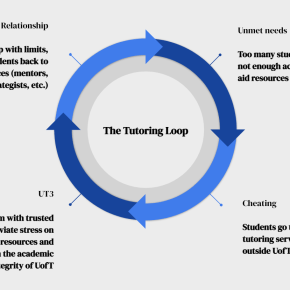
The Price of Support: How The UT3 Program Complicates Academic Aid
By Molly McGouran While conducting research into the University of Toronto Tutor Training Program (UT3), I found myself caught in a web of questions and answers that seemed to lead me in circles. The more fieldwork I did, the more it felt like trying to solve a puzzle where every piece connected to another in … Continue reading
Resource-Reliant or Resource-Ready? UofT’s Approach to Professionalized Student Tutors
By Molly McGouran t UofT, being the ideal professionalized student-tutor is about more than just excelling in your studies or helping others with theirs. The University of Toronto Tutor Training Program (UT3) has a clear vision of what an ideal student-tutor should be: vigilant, honest, ethical, and, above all, well-informed. But what does that actually … Continue reading
Assessment vs Evaluation
By Maia de Caro My project concentrates on assessment as an overarching topic and is honing in on the Signature Program Assessments (SPAs), a unit-level assessment mechanism grounded in objectives set out by the Strategic Plan that promotes student success and development. One key insight from my research was the emphasis made by my interlocutors … Continue reading
Surveys – Issues of Neutrality
By Maia de Caro My project is rooted in trying to understand assessment practices in the division of Student Life. To give me a more specific focus, I looked into the Signature Program Assessments (SPAs), a unit-level assessment tool connected to actionable goals outlined in the Strategic Plan. Since there were no SPAs running at … Continue reading
The Assessment Cycle – Storytelling
By Maia de Caro The Assessment Cycle is composed of five stages: 1) Assessment Plan Development, 2) Implementation, 3) Analysis & Summary, 4) Storytelling, and 5) Action Planning & Next Steps. This blog post focuses on Storytelling. My project began by trying to understand assessment within the division of Student Life and evolved into a … Continue reading
The Undocile mind: ‘coping’ with neoliberal education?
A Final Report by Lukey Lu Imagine you are an undergraduate student now approaching the end of the semester in the University of Toronto. You just finished some term tests and survived through some assignments. You thought you are doing fine — everything is under the control. However, the reality soon slaps your face: you … Continue reading