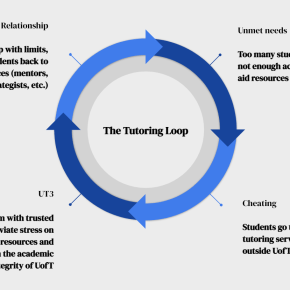
By Molly McGouran t UofT, being the ideal professionalized student-tutor is about more than just excelling in your studies or helping others with theirs. The University of Toronto Tutor Training Program (UT3) has a clear vision of what an ideal student-tutor should be: vigilant, honest, ethical, and, above all, well-informed. But what does that actually … Continue reading
Author Archives: Emily Hertzman
Assessment vs Evaluation
By Maia de Caro My project concentrates on assessment as an overarching topic and is honing in on the Signature Program Assessments (SPAs), a unit-level assessment mechanism grounded in objectives set out by the Strategic Plan that promotes student success and development. One key insight from my research was the emphasis made by my interlocutors … Continue reading
Surveys – Issues of Neutrality
By Maia de Caro My project is rooted in trying to understand assessment practices in the division of Student Life. To give me a more specific focus, I looked into the Signature Program Assessments (SPAs), a unit-level assessment tool connected to actionable goals outlined in the Strategic Plan. Since there were no SPAs running at … Continue reading
The Assessment Cycle – Storytelling
By Maia de Caro The Assessment Cycle is composed of five stages: 1) Assessment Plan Development, 2) Implementation, 3) Analysis & Summary, 4) Storytelling, and 5) Action Planning & Next Steps. This blog post focuses on Storytelling. My project began by trying to understand assessment within the division of Student Life and evolved into a … Continue reading
The Undocile mind: ‘coping’ with neoliberal education?
A Final Report by Lukey Lu Imagine you are an undergraduate student now approaching the end of the semester in the University of Toronto. You just finished some term tests and survived through some assignments. You thought you are doing fine — everything is under the control. However, the reality soon slaps your face: you … Continue reading
Rethink of the ‘university’: What is a university?
By Lukey Lu “What is a university?” This may seem like a simple question, but I believe everyone has their own answer — these answers may be diverse and different among individuals. However, if we deeply reflect on this word, we may realize the difficulty in defining it. The ‘university’ can connote many things: the … Continue reading
Learning Strategists’ counter-hegemonic practice: English or Englishes?
By Lukey Lu “You belong to English. English belongs to you. There’s nothing wrong with you. You don’t need to apologize for your English. Right? Like so we talked about kind of big picture principles (to the students). But yeah, absolutely, in practice, how do you implement?” This is a quotation from my interviewee Frank … Continue reading
‘Beyond Foucault’: Compatibility of Discourse Analysis and Phenomenology in Ethnographic Research Methodology
By Lukey Lu Speaking of contemporary social science and humanities, Michel Foucault is definitely a figure that is impossible to ignore. Foucauldian thinking towards discourse and power greatly influences contemporary anthropologists. In her work, Foucault Foments Fieldwork at the University, Prof. Li introduces the advantages of incorporating a Foucauldian way of thinking about the ‘university’: … Continue reading
Empowering Learners, Transforming Institutions:Learning Strategists’ Role in Higher Education
A Final Report By Hanisha Mistry Introduction The fluorescent light hummed softly in the temporary office on Bay Street, a functional yet impersonal space where the Centre for Learning Strategy Support (CLSS) had set up during the Koffler Student Centre renovations. Despite its unremarkable setting, the CLSS is defined not by its location but by … Continue reading
The Complementary Roles of Mentors and Strategists
By Hanisha Mistry There is a need for Student Life’s resources, and there is a reason why we have both peer mentors and Learning Strategists. A poignant quote from a conversation I had with a Learning Strategist captures this need: “Students are saying, ‘I need to talk about my learning in not an evaluated space.’” … Continue reading