By Yihang Xu “… even just in the few conversations we’ve had, you’ll notice that there’s almost a departmental identity crisis…” —— Grace, Learning Strategist Grace is right. Through my interviews with learning strategists in the Center for Learning Strategy Support (CLSS) at the University of Toronto (UofT), I’ve noticed an identity crisis among them. … Continue reading
Author Archives: Emily Hertzman
Neoliberal Implications in the Fragmentation of Student Services through the renamings of Center for Learning Strategy Support (CLSS)
By Yihang Xu The Center for Learning Strategy Support (CLSS) helps students develop strategies and practices to enhance their learning and study skills. As one of the major units within the Student Life Department at the University of Toronto (UofT), CLSS didn’t always exist in its current form. According to my informant, Eric (a pseudonym), … Continue reading
Scaling Academic Support Services: Consumerist Implications in Higher Education
By Yihang Xu The Center for Learning Strategy Support (CLSS) is a major academic support service provider within the University of Toronto (UofT). Its focus is on helping students improve their learning habits and academic outcomes. During my interviews with the learning strategists there, I found that they frequently use the word “scale” to describe … Continue reading
Power through Professionalization: Power Dynamics in Student Peer Mentorship
A Final Rport By Richard Wu First-year students of a course required for entry into the Statistics Major/Specialist degree programs trickle into a conference room to learn about academic writing, in a workshop organized by upper-year student mentors hired by the Statistics Department at the University of Toronto (U of T). Tony, a peer mentor, … Continue reading
The Art of Building Rapport with Professionals
By Richard Wu One might think that, for the student ethnographic researcher, Student Life offers abundant opportunities for immersive field research. After all, like other students, the student researcher should in principle have equal access to the many opportunities for student engagement and development which Student Life is mandated to provide. Yet, as a student … Continue reading
Get Trained to be a Good Mentee
By Richard Wu How great would it be if someone, perhaps a more senior student, can show you the ropes about how to succeed at U of T? Someone with the right personality, background, and interests who can click with you and provide support and guidance? This might sound great. But how do you get … Continue reading
The Peer Mentorship Contract
By Richard Wu Let me tell a story of how “contract” comes to be used in student peer mentorship. In theory, university students could form stable, mutually beneficial relations to help each other succeed. In such peer mentoring relations, more junior students are mentees who could benefit from the guidance and support of more senior … Continue reading
The Business of Helping: The Ethical Implications of Student Tutoring at UofT
A Final Report By Molly McGouran Introduction Why do we behave with integrity? This was the first question I was asked when I logged onto “Ethics in Tutoring,” the first of my Zoom sessions in the Tutor Training Program. As I sat at my laptop, confronted with this question, I was opened up to the … Continue reading
When the Field Says No: Researching Student Life Without Student Voices
By Molly McGouran How do you conduct research on a university without talking to students? It is a question that caught me off guard during my fieldwork and, at first, felt incredibly limiting. I had started with what I thought was a clear, straightforward plan: observe, interact, and interview students at the University of Toronto. … Continue reading
The Price of Support: How The UT3 Program Complicates Academic Aid
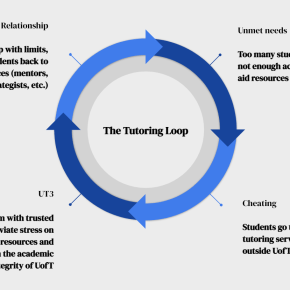
By Molly McGouran While conducting research into the University of Toronto Tutor Training Program (UT3), I found myself caught in a web of questions and answers that seemed to lead me in circles. The more fieldwork I did, the more it felt like trying to solve a puzzle where every piece connected to another in … Continue reading