Raine-Liette Blanchard
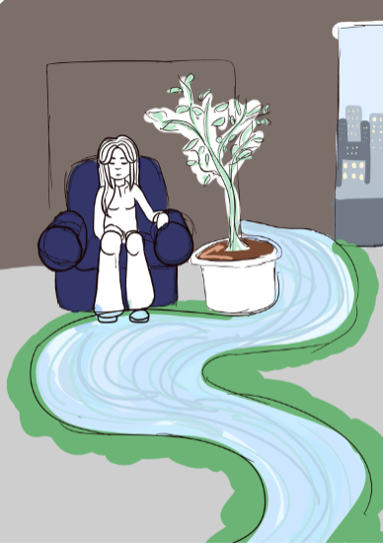
Quick Sketch of Silent Space (the sound of a/c in the room reminded me of the river back home)
Stashed away on the fourteenth floor of the University of Toronto’s most popular library; down confusing hallways, with uninviting concrete floors and cement walls, lies the East Asian Studies department. This was the location where I spent much of my time throughout my fieldwork. Often sitting in the lounge-room, with its bright colours, carpeted floors, and large-scale windows; a vibrant contrast to the starkness of the rest of the level. The title of my study was synthesized as “Preservation of East Asian Studies in Corporatization of the University of Toronto.” The fieldwork was conducted as part of ANT380: Craft of Social/Cultural Anthropology and it took around 3 months (September-December) including the initial idea phase and wrapping up the end report in early December. As a second-year student, this class was my introduction to fieldwork and ethnography. Similar to others in my position, I experienced many difficulties while also having a lot of fun along the way, so I wanted to share my experiences and offer tips for future students in my position. My biggest difficulty and enemy along the way was my indecision. Initially I had considered several ideas before determining a topic I thought I would enjoy. I thought choosing to study the East Asian studies department would aid my immersion into the department, and answer questions I had outside of classes. My initial direction, studying orientalism and a cold-war mindset within the department, was de-railed by the passionate interests of my interlocutors. I got the most information not from asking questions about my original topic, but when my interlocutors told me stories unrelated to my questions. Stories about laughing with colleagues, being celebrated, and frustrations over
how the department is treated. This wasn’t a problem, and in fact I’d encourage others to engage further in what their interlocutors like to discuss, since that brought me to pathways I couldn’t have anticipated, such as staff dynamic and support. My indecision hit me the hardest towards the end of the assignment. I had left ample time to review my research, organize it, and choose a topic. Or so I thought. Several 9 hour days of combing my notes, organizing them, colour coding, frantically writing down topic after topic to eventually choose something. Did I choose correctly? If I gave my notes to various people, they might all choose different angles while still being great conclusions. One flaw that hindered my final progress was my penchant for handwritten notes. To my future self, I would suggest digital transcription of notes, reducing my final workload. What ultimately brought me to my final title was following the direction my interlocutors had steered me, rather than relying solely on my own decision while also following my data flow. This created the results I was most happy with. This was an enjoyable beginning to my fieldwork and ethnography journey. I’ve learned many lessons from the difficulties I faced during the project and I’m excited to return to fieldwork with everything I’ve learned. In addition to better planning and transcription, being open to guidance by interlocutors, I’d recommend allowing yourself to change avenues if necessary. Overall, I am grateful for the opportunity to have conducted this fieldwork, and plan to take these lessons into future projects.
 Ethnography Lab