Nida Islam
We sat in the private library room chatting after completing our interview. There was an ease to the conversation, despite it being the first time we had met. We ended up speaking for over 3 hours.
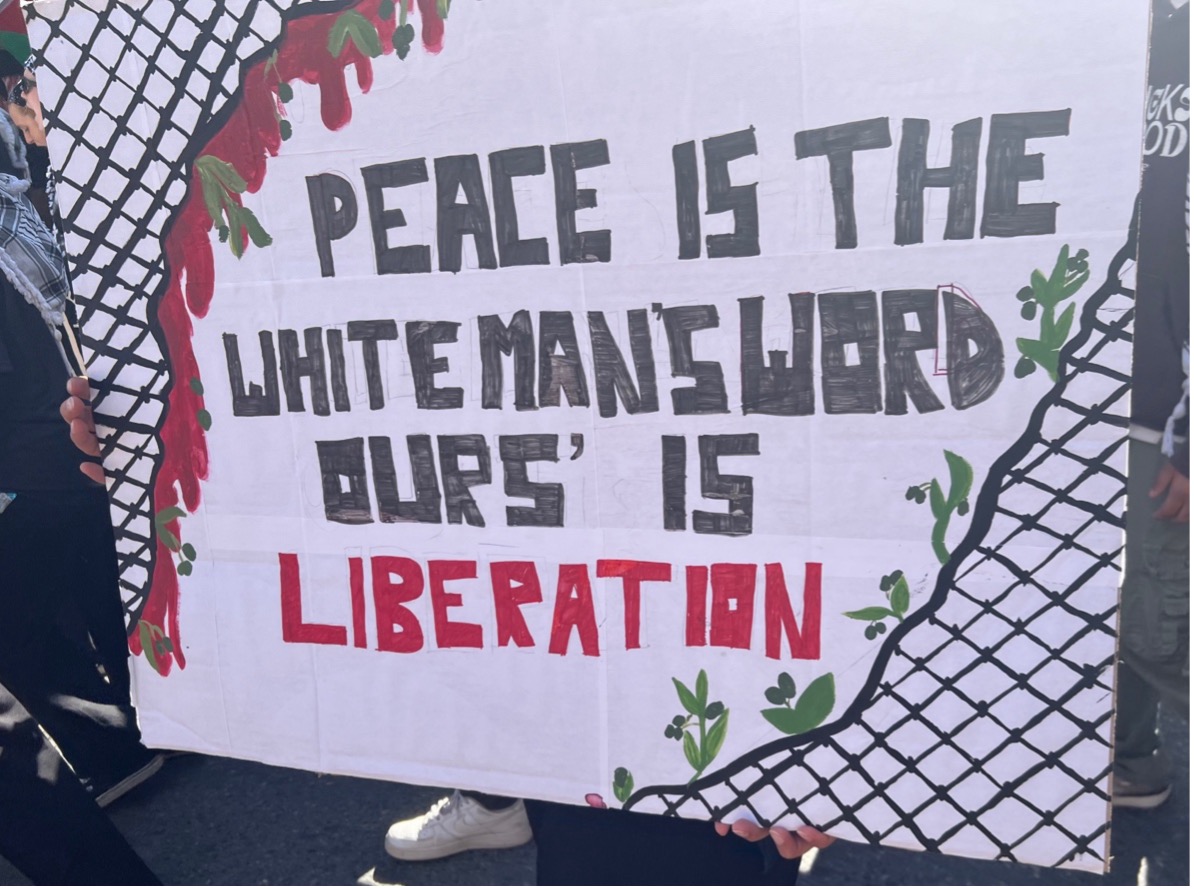
Perhaps it had something to do with the unspoken bond hijabis share, the one that prompts us to make eye contact, smile and mumble “salaam” when we pass each other in public. Maybe it had something to do with the gravity of the conversation we had just had – the one about Palestine and protest, and the meaning and meaninglessness of taking on the whole system. There was a shared project between us, a common goal, akin to the feeling of camaraderie I felt standing in the crowd of keffiyehs at the protest.
I wondered if she had any questions for me. “Why Palestine?” she asked. “You’re Bangladeshi, right? Didn’t Bangladesh just have a revolution? Why not write about that?”
I paused.
She had marked me out, marked me as separate – not Palestinian, and therefore with no obvious personal investment in the cause, no skin in the game. So why was I writing about Palestinian protest?
A million thoughts ran through my head in the span of a few seconds. I could dismiss the question; tell her I’d work on that in a future project. I could be superficial; tell her I felt Palestine was the more interesting and topical issue. I could give her a half-truth that didn’t fully answer her question, tell her that I had been invested in the question of Palestinian liberation and protest for much longer, that I had a better background in it than Bangladeshi politics. I ended up with something perhaps more honest than that.
I recall sharing that “there’s something about the question of Palestine, something that makes the idea, that hope for liberation, real. The thing with Bangladesh, and a lot of underdeveloped countries, is that they’re tied up in these networks of dependency that make the idea of true liberation so much further off. Bangladesh built its economy on cheap labour and foreign aid. When people protest in Bangladesh, it’s because they’re discontent with the status quo, but true liberation seems like a pipe dream. True liberation needs so much more than a change in leadership. When we march on the streets in Toronto and cheer ‘Free Palestine!’, we don’t do so figuratively. It’s not a metaphor. We see a future where there is a free Palestine. And that means something.”
What I communicated in that moment was the force I felt when I marched in the streets. That our voices, chanting, came together to manifest a physical force that demanded a free Palestine, in all its meaning.
I was also pulling on a thread of conversation from a previous interlocutor, who told me these ideas of decolonization, of anti-imperialism and true liberation for all colonized peoples, “they’re
inherent in the question of ‘free Palestine’. We don’t need to elucidate that point any further. Because at the end of the day, it’s about that land. It’s about the return to the land.”
And so it’s through the land that I try to weave together seemingly disparate colonial experiences to build the image of protest as a vision for the future. I wonder if that’s what makes it real.
 Ethnography Lab