Lita Wanjiru Ngure
My research site was the Arts of Global Africa & the Diaspora exhibit at the Art Gallery of Ontario (AGO). I grew up in Kenya, and my entire family has been fortunate to call Nairobi home. This past summer, my aunt came to visit me in Toronto and, as one does when creating an itinerary for their loved ones, we visited all the tourist spots, including the AGO. Upon our arrival, my aunt was eager to go to the Arts of Global Africa exhibit to discover how our continent is represented to Torontonians. She was quickly disappointed and had quite an animated reaction, expressing her discontent with the effort put into the display. Based on this interaction, I decided to focus my research on how exhibits such as these construct the image of Blackness and African identity, both in the minds of the African diaspora and people outside the community. Throughout my research, I situate the AGO within an ecosystem of institutions that function as sites of authority, legitimising certain narratives about Blackness and African identity. I understand instituting as a process that orders, reorders and stabilises culture (Ahmed, 2015). Through hosting a variety of visitors, the works on display are constantly in dialogue with people’s preconceived ideas, allowing them to walk away with constructed understandings of those represented. hooks (1992) tells us that the “gaze” is always political. The power of looking constructs the viewer, regardless of whether they consent to it or not.
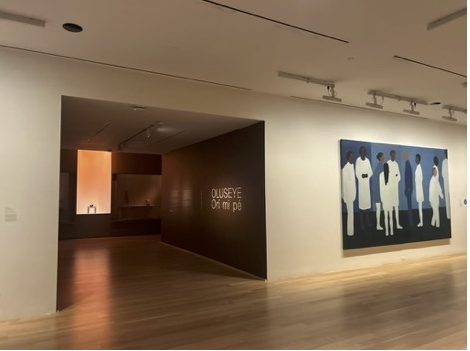
This image shows the exhibit’s limited visibility compared to the surrounding exhibits. The layout withholds a comprehensive view, mirroring its controlled curatorial logic.
A major point of inquiry was the fact that the exhibit’s lead sponsor is TD Bank. Many of my interlocutors expressed how they found the sponsorship distasteful. In TD’s attempt to whitewash its image, the presence of its logo was seen as evidence of institutional hypocrisy falling short of the cultural investment it claims to be. Similarly, I questioned the sponsorship of the singular Caribbean item at the exhibit. It is a large statue, a sculpture of a Moko Jumbie, a man on stilts typically found at Carnival (Traditional Mas Archive, n.d.). Interestingly, it was commissioned by Ray and Georgina Williams and white philanthropist David W. Binet. One of my interlocutors initially thought that Ray and Georgina were also white, despite them being Black, showing how philanthropic authority within museums is racialised as white by default, further revealing how institutional power is commonly imagined as incompatible with Blackness. This perspective reveals that to the viewer, Black people are expected to appear as subjects of representation, not as patrons. Insofar as we view the gallery as an institution that mediates and negotiates Black identity, this shows that Black presence is legible to Westerners, while Black authority is not. Just like the idea of big banks sponsoring the exhibit should be called into question. I place philanthropy within the institution of white supremacy. While deviating from corporate mechanisms, it still negotiates Blackness on racist terms. TD, philanthropy and by extension capitalism’s ferocious appetite demands that visual media is treated as a commodity (Ball, 2010). Recognising the West’s relationship to the histories of colonialism and slavery, one can position the Black body and, by extension, Black culture as the West’s original commodity fetish (Ball, 2010). The findings of my research show that TD, philanthropy and the AGO, whose histories are bound up in that commodification, function by resituating African art within circuits of capital accumulation.
 Ethnography Lab