By Richard Wu
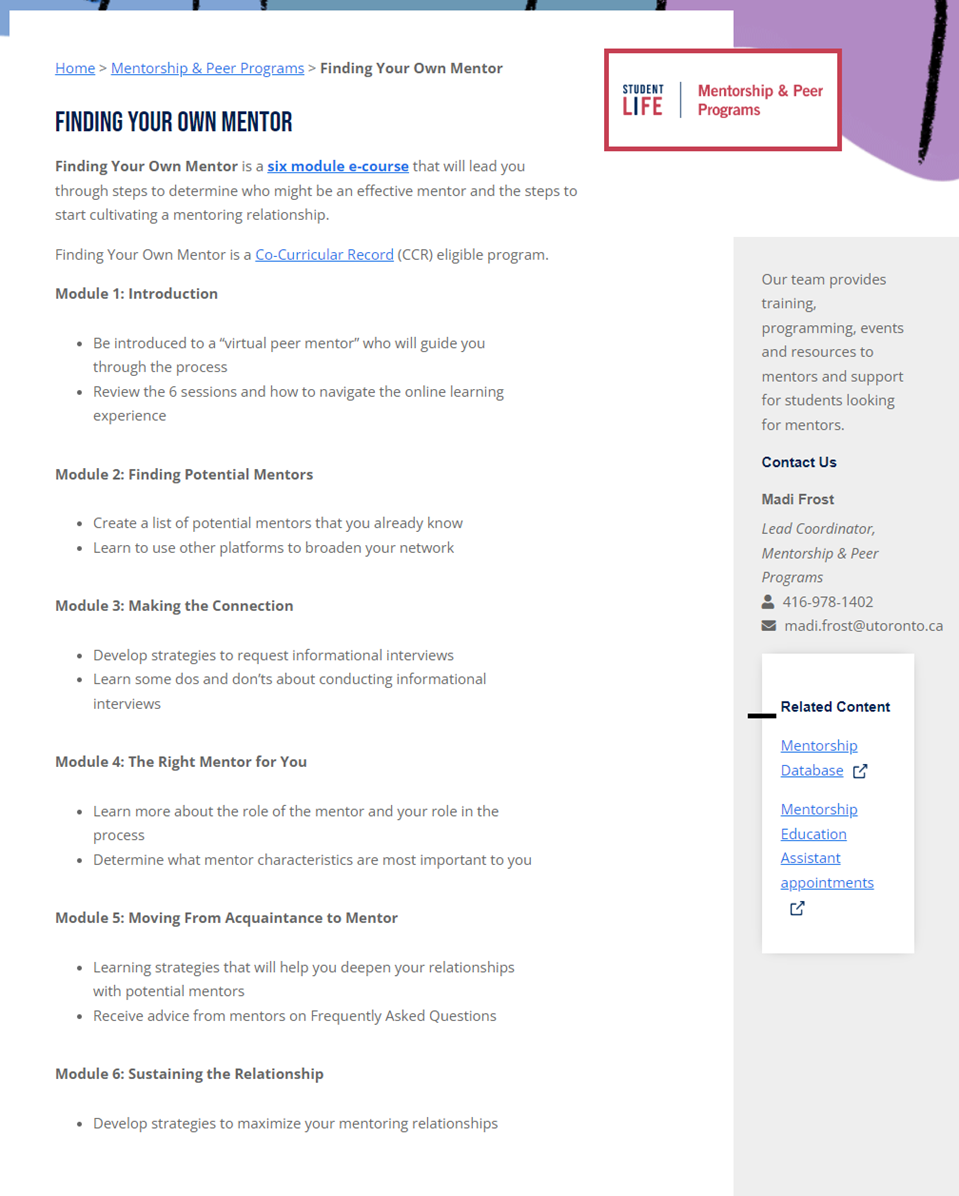
How great would it be if someone, perhaps a more senior student, can show you the ropes about how to succeed at U of T? Someone with the right personality, background, and interests who can click with you and provide support and guidance? This might sound great. But how do you get started finding such a unique mentor? This task may be especially difficult at a large university like U of T. Responding to this difficulty, the division of Mentorship and Peer Programs at U of T’s Student Life hosts an e-course called Finding Your Own Mentor. At first glance, the e-course functions as a guide for potential mentees who are looking to find the right mentors for themselves. Upon closer analysis, however, one finds that the e-course is, in effect, a tool for training the ideal mentee, someone who would respect a set of expectations formalized by Student Life about the “best practices” of student peer mentorship. We may understand the e-course’s “mentee training” as involving an individualizing element and a formalizing element.
The individualizing element of the e-course trains potential mentees into someone who takes individual responsibility for finding the right mentor and for contributing to the success of the mentoring relation. This training occurs through the e-course’s use of voice narration, which presents a persona who comes across as cheerful and caring. This is Kim, “your virtual peer mentor” (Module 1). Kim speaks with a soft tone, expressing an embracing attitude and conveying a sense of interpersonal closeness. Kim encourages potential mentees to account for their individual characters and preferences in choosing mentors. Kim’s narration invites the feeling that one is being offered caring guidance as a unique individual. Yet, the e-course emphasizes the individual student’s responsibility to methodically select, plan, and strategically develop peer mentorship relations with clear goals in mind.
The formalizing element of the e-course trains potential mentees to recognize mentorship as a technically defined mode of social interaction. It defines “peer mentorship” with a high degree of specificity, as “mentoring + relationship”: a particular kind of “reciprocal” social relation built over many “mentoring conversations” over time, whereby a mentor engages in the “action of sharing their experiences with you, asking questions to help facilitate your growth and development” (Module 1 – Mentoring Relationships). It moreover presents mentorship issues as well-formulated problems that can be addressed by specific techniques of social interaction. For example, Module 6’s “Strategy” and “Relationships” sections technically formulate a “3 Cups of Coffee Problem”: Running out of things to talk about with your mentor after the third coffee chat meeting? This is because you have developed a “transactional” rather than a “transformative” relationship. To cultivate “transformative relationship”, the module suggests several techniques to the potential mentee: “Attend a speaker event or conference together”; “read an article of interests to both of you and discuss it”.
You may not be surprised to hear that it takes training to be a good mentor. Yet, it turns out it takes training to be a good mentee, too! Student Life’s e-course exemplifies an institutional attempt at training good mentees of out of students.
 Ethnography Lab