By Angelina Nguyen, Norah Rahman and Richard Wu
Our collective fieldwork revealed some ambiguity concerning how student roles are portrayed in Student Life (SL) discourse and how they work out in practice. Below we discuss student roles as labourers, consumers, and advisors.
Student as workers: SL employs hundreds of work-study students and spends over a million dollars on student wages, yet does not view itself as reliant on student labour. On SL website the work-study program is portrayed as an opportunity for students to “deepen knowledge, strengthen skills, and explore how academic studies translate to career possibilities”.
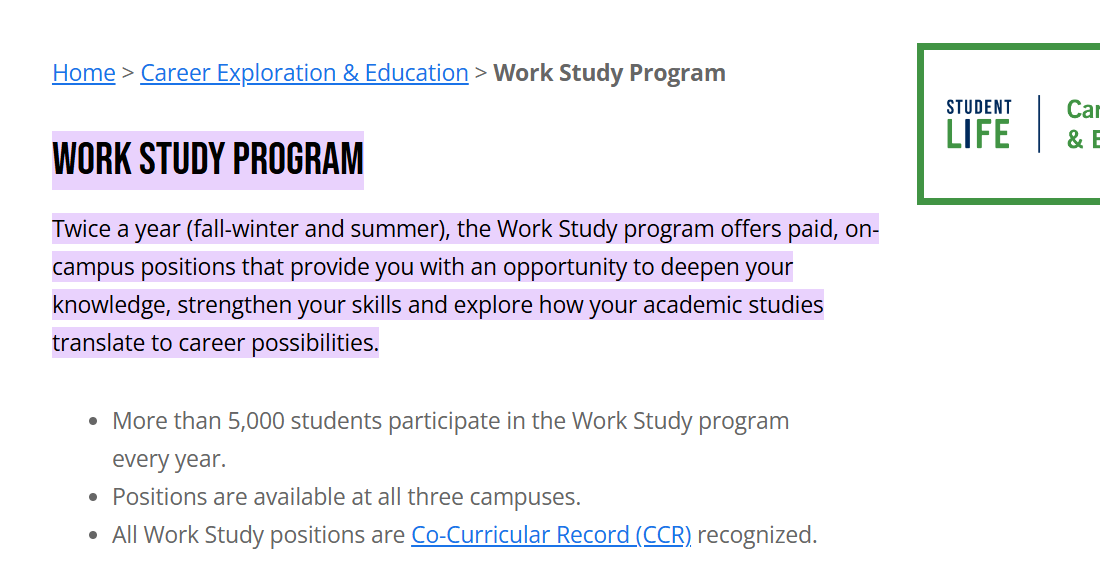
(Screenshot Via – Work Study Programs – UofT Student Life)
In reality, the jobs students do are essential to SL functioning. Work-study students often serve in
front-facing, service-oriented positions (e.g., Ask Me Anything guides or campus tour guides). Yet, they are mostly paid minimum wages. Thus, the use of student labour, while undoubtedly providing students with valuable experience, also mitigates costs.
Student as consumers: The SL website uses marketing techniques to entice students to consume SL services. YouTube videos featuring student verbal recommendations and written testimonials (e.g., “What Students are Saying”) accompanied by a five-star rating system are standard affairs.

(Screenshot via:Mentorship & Peer Programs – UofT Student Life )
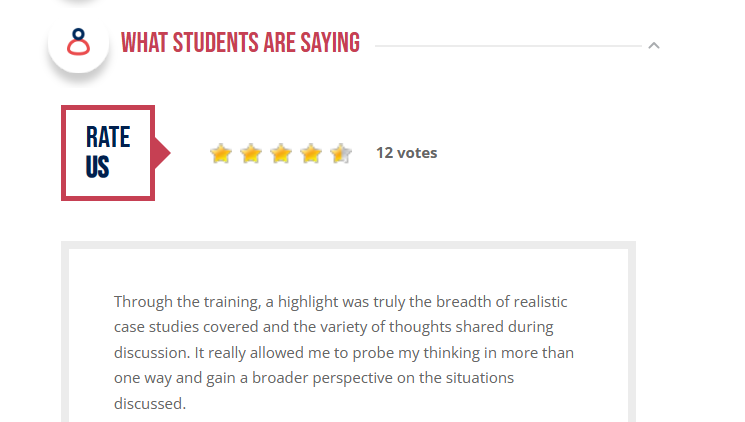
(Screenshot via:Mentorship & Peer Programs – UofT Student Life )
Despite such marketing, SL staff tend to eschew seeing students as “customers” or “clients”. For many staff these terms fit awkwardly with what they see as their non-profit service-oriented profession where the goal is not to sell something to students but to “mentor” or “advocate for” them. Likewise, rather than seeing themselves as consumers, many students see SL as providing valuable experiential learning geared towards personal development.
Student as advisors: Each year, SL central administration recruits students to serve in advisory roles (e.g., The Council on Student Services (COSS) and Student Life Advisory Committee (SLAC)). The discourse attached to these initiatives is that student advisors will provide input and share concerns with SL administrators, who then act as their advocates. According to the SL website, students “help guide Student Life”.
In practice, the effective power of student advisors is limited. Student feedback does not cycle directly into SL services or policies. At COSS/SLAC meetings, student advisors articulate issues that are important to them; yet, the only power they actually have is voting for or against changes to student fees.
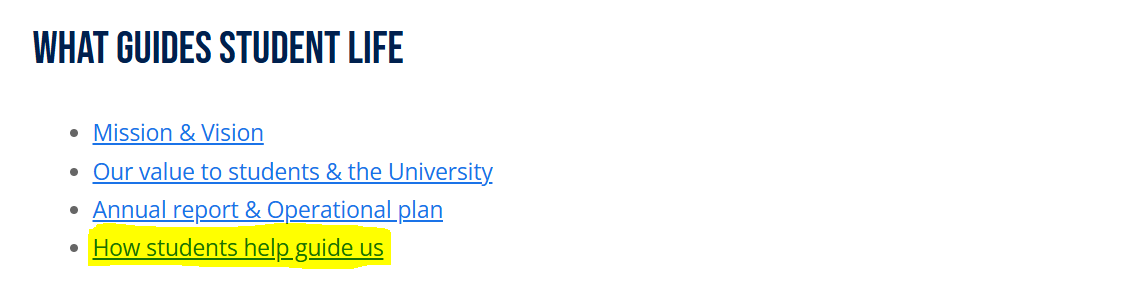
(Screenshot Via – Student-Life-About- UofT Student Life)

(Screenshot Via –How-Students-Help-Guide-Us- UofT Student Life)
Our ethnographic investigations thus reveal an ambiguity that seems to circulate across different sites within SL: a disconnect between discourse and practice. SL’s different divisions design and provision plenty of opportunities for students to participate in different roles. Yet, SL staff’s discursive representations of these roles can often diverge from the practical ways in which students actually take up these roles. This ambiguity, moreover, does not seem to be at the forefront of the consciousness of students and SL staff. In its circulation, the ambiguity appears to be naturalized.
 Ethnography Lab